
Blog
Harit Kranti (Green Revolution) in India

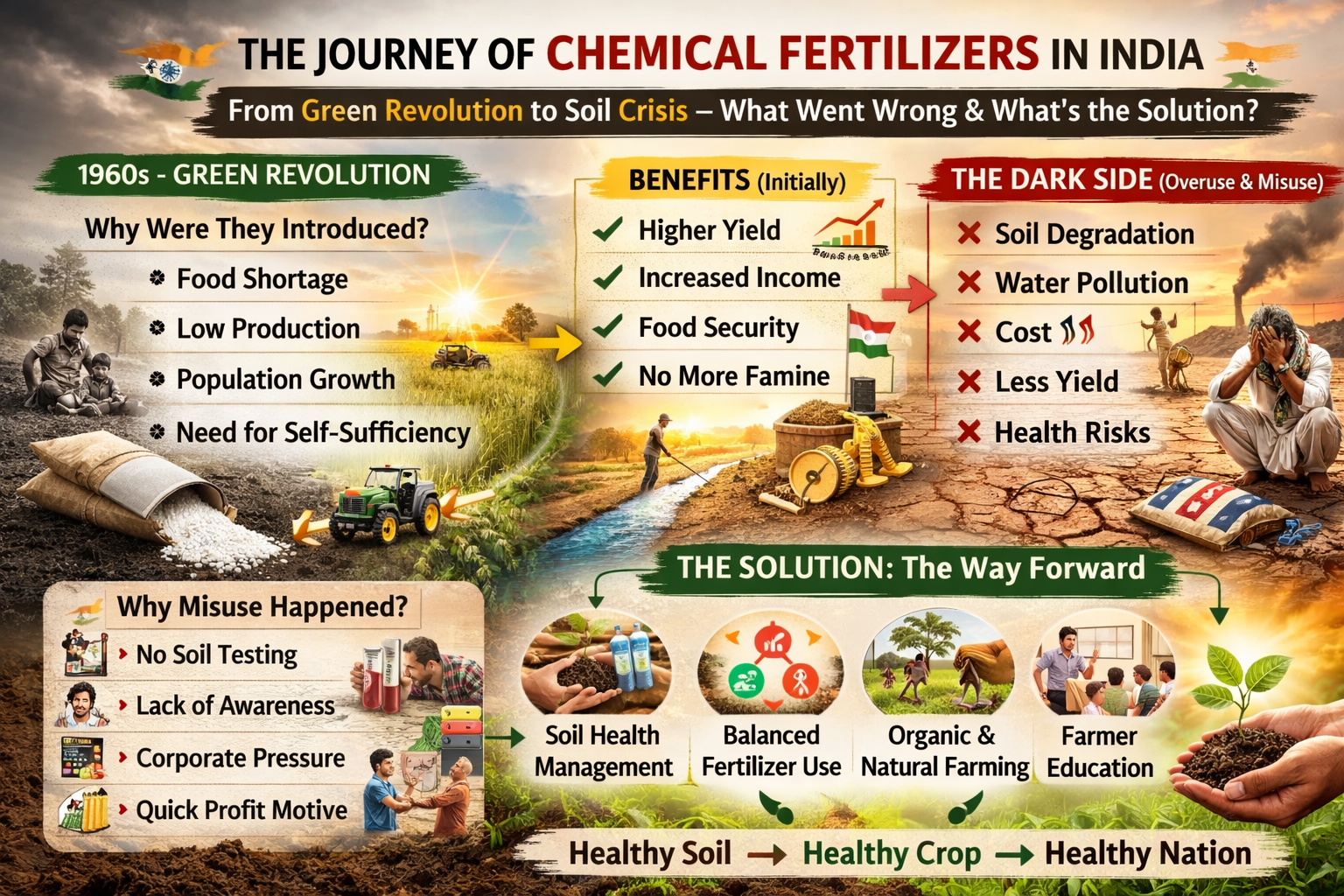
Why Chemical Fertilizers Were Introduced — Benefits, Misuse & The Way Forward
India once faced severe food shortages. In the 1960s, the country was dependent on food imports and struggled to feed its growing population. This crisis led to one of the most important agricultural transformations in history — Harit Kranti, also known as the Green Revolution.
But while it solved one problem, it slowly created another.
Let us understand everything clearly.
Harit Kranti Kya Hai?
Harit Kranti (Green Revolution) was an agricultural movement started in the 1960s to increase food grain production in India.
It was promoted with:
- High-yield variety (HYV) seeds
- Chemical fertilizers
- Pesticides
- Irrigation expansion
- Modern farming machinery
The main objective was simple:
Increase food production rapidly to prevent hunger and famine.
Why Chemical Fertilizers Were Introduced
Chemical fertilizers were introduced because traditional farming methods were not producing enough yield to feed the growing population.
At that time, chemical fertilizers:
- Gave faster crop growth
- Increased grain size
- Improved production per acre
- Reduced crop failure risk
- Helped India become self-sufficient in wheat and rice
From a national food security perspective, it was a major success.
Benefits of Chemical Fertilizers During Harit Kranti
At that time, the benefits were significant:
✔ Rapid increase in food production
✔ Improved farmer income initially
✔ Reduced dependence on food imports
✔ Prevention of famine-like situations
✔ Strengthened national food security
India transformed from a food-deficit nation to a food-surplus nation.
What Went Wrong Later?
The problem was not introduction — the problem was overuse.
Over time:
- Fertilizers were used without soil testing
- Farmers believed “more fertilizer = more yield”
- Soil organic matter was ignored
- Crop rotation reduced
- Pesticide dependence increased
Gradually, soil health started declining.
Misuse and Overdose of Chemical Fertilizers
Major misuse included:
- Excessive nitrogen-based fertilizer use
- Ignoring soil health balance
- Applying fertilizers without soil health card analysis
- Repeated mono-cropping (same crop every season)
This caused:
- Soil nutrient imbalance
- Decline in soil organic carbon
- Reduced microbial life
- Hard soil structure
- Water pollution
- Increased farming cost
In many areas, yields plateaued despite increasing fertilizer doses.
Are Farmers Fully Aware of Overdose Risks?
Many small farmers:
- Were not properly educated about balanced fertilizer use
- Did not receive enough soil health management training
- Relied on dealer recommendations
- Focused on short-term yield
Awareness gaps contributed to misuse.
However, it is important to note — most farmers acted with the intention of increasing production, not harming soil.
Why Do Corporates Sell More Chemical Fertilizers?
Corporates operate on business models based on volume sales.
Key reasons include:
- Higher profit margins on chemical inputs
- Government subsidies on certain fertilizers
- Strong distribution networks
- Marketing influence
- Limited promotion of organic alternatives
This created a cycle where chemical fertilizer became the default solution.
What Is Real Health in Agriculture?
Real agricultural health means:
- Living soil with active microbes
- Balanced nutrients
- High organic carbon
- Sustainable yield
- Chemical-free food
- Environment protection
Healthy soil leads to healthy crops.
Healthy crops lead to healthy families.
The Solution: Moving Toward Sustainable Farming
The goal is not to completely blame the Green Revolution. It served its purpose at that time.
But now, the solution lies in balance.
1. Soil Health Management
- Regular soil testing
- Use of soil health card
- Balanced nutrient application
- Reduced chemical dependency
2. Vermicompost & Organic Inputs
Natural compost and vermicompost:
- Improve soil structure
- Increase microbial life
- Restore organic carbon
- Reduce fertilizer requirement
3. Crop Rotation & Natural Farming
- Diversified cropping
- Use of bio-fertilizers
- Cow-based natural farming inputs
- Reduced pesticide use
4. Farmer Awareness & Education
- Training on sustainable practices
- Demonstration farms
- Long-term soil preservation mindset
Overcoming Chemical Dependency
To overcome overuse:
- Gradually reduce chemical fertilizer doses
- Combine with organic fertilizer
- Improve soil organic matter
- Promote home gardening and natural farming
The transition must be practical, not extreme.
Conclusion
Harit Kranti was necessary for India’s survival.
But long-term soil health was overlooked.
Today, the challenge is different:
Not just producing more food —
but producing nutritious, chemical-safe, sustainable food.
The future lies in restoring soil health while maintaining productivity.
Balanced farming is the path forward.
Healthy Soil → Healthy Crop → Healthy Nation.