
Blog
Natural Farming in India: A Sustainable Future for Health and Farmers

What is Agriculture?
Agriculture is the foundation of civilization. It is the process of cultivating land, growing crops, and raising livestock to provide food, fiber, and essential raw materials. India, being an agrarian economy, depends heavily on farming for livelihood and food security.
However, over the past few decades, chemical-based agriculture has increased production but also led to soil degradation, rising input costs, and health concerns. This is where natural farming in India emerges as a powerful and sustainable alternative.
What is Natural Farming?
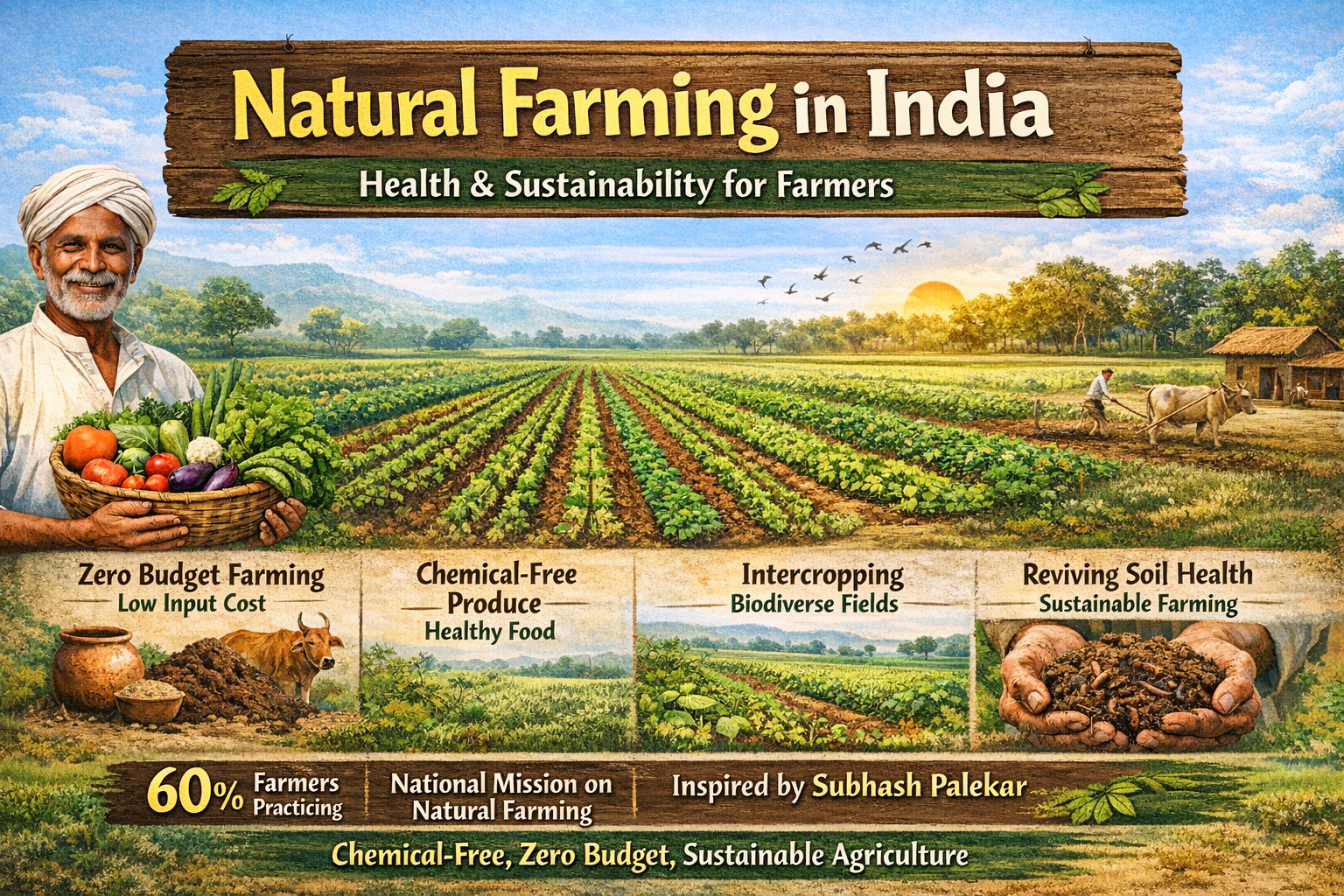
Natural farming is a chemical-free farming method that works in harmony with nature. It avoids synthetic fertilizers, pesticides, and herbicides. Instead, it relies on cow-based formulations, crop diversity, and natural resources for farming such as soil microorganisms, sunlight, water, and biodiversity.
Unlike chemical farming, the input cost is almost zero, especially in traditional models like Zero Budget Natural Farming (ZBNF).
Key Principles:
- No chemical fertilizers or pesticides
- Use of indigenous cow-based inputs
- Soil regeneration and microbial activity
- Mixed cropping and intercropping
- Low-cost sustainable agriculture
Origin of Natural Farming in India
The modern movement gained momentum through Zero Budget Natural Farming, popularized by agricultural reformer Subhash Palekar. He developed a natural farming model based on traditional Indian knowledge systems.
His philosophy emphasized:
- Farming without loans
- Zero budget natural farming
- Chemical-free soil restoration
- Sustainable income for farmers
Today, the Government of India promotes this approach under the National Mission on Natural Farming, which supports farmers transitioning from chemical to natural practices.
Natural Farming Project & Government Support
The Indian government has launched several natural farming projects to expand this movement.
Under national schemes:
- Farmers receive training and awareness programs
- Clusters are formed for natural farming adoption
- Financial assistance for transitioning farmers
- Promotion of chemical-free produce in markets
The objective is to reduce dependency on chemical imports and promote sustainable agriculture practices across states.
How Long Has India Been Practicing Natural Farming?
Traditional Indian agriculture was naturally chemical-free for thousands of years. However:
- Chemical farming increased after the Green Revolution (1960s).
- The revival of natural farming began strongly around 2010 onwards.
- Currently, lakhs of farmers across multiple states practice natural farming.
Though exact percentages vary, natural farming is steadily increasing due to rising awareness about soil health and consumer demand for chemical-free food.
Natural Resources for Farming
Natural farming depends on:
- Soil microorganisms
- Cow dung and urine (especially indigenous cows)
- Crop residues
- Rainwater and sunlight
- Biodiversity
These natural resources for farming help maintain soil fertility without synthetic inputs.
Intercrop & Crop Diversity in Natural Farming
Intercropping is a major component of natural farming.
What is Intercrop?
Intercropping means growing two or more crops together in the same field.
Benefits:
- Improves soil fertility
- Reduces pest attacks naturally
- Increases farmer income
- Maximizes land productivity
- Enhances biodiversity
For example:
- Pulses with cereals
- Vegetables with fruit trees
- Millets with legumes
This system creates a balanced ecosystem and reduces risk.
Why Farmers Should Adopt Natural Farming
1. Zero Budget Natural Farming
Input cost is extremely low because farmers use local resources instead of buying chemicals.
2. Improved Soil Health
Natural microbes revive soil fertility over time.
3. Better Market Demand
Consumers now prefer chemical-free, natural products.
4. Health Protection
Chemical-free food protects families from harmful residues.
5. Sustainable Income
Reduced dependency on fertilizers and pesticides means better profit margins.
Changes Observed in Soil & Farmers’ Lives
Farmers practicing natural farming report:
- Increased earthworm activity
- Improved soil structure
- Reduced water requirement
- Lower crop failure risk
- Improved long-term yield stability
The soil becomes living and fertile again.
Zero Budget Natural Farming UPSC Perspective
From an academic point of view, Zero Budget Natural Farming UPSC is often discussed under:
- Sustainable agriculture
- Environmental conservation
- Rural development
- Climate-resilient farming
It aligns with Sustainable Development Goals (SDGs) related to food security and environmental protection.
Why Farmers Basics Supports Natural Farming
At Farmers Basics, we source directly from farmers who practice natural and chemical-free farming.
We believe:
- Health is more important than high production
- Soil health means family health
- Supporting farmers ensures sustainable agriculture
Our mission is to reconnect families with responsibly sourced, naturally grown food from trusted Indian farmers.
Conclusion
Natural farming in India is not just a farming technique — it is a return to roots. It reduces input costs, restores soil health, improves farmer income, and protects consumer health.
With increasing support from the National Mission on Natural Farming, awareness about zero budget natural farming, and rising demand for chemical-free food, the future of Indian agriculture is steadily moving towards sustainability.
For farmers, it is a path of independence.
For consumers, it is a path of health.
For India, it is a path of long-term agricultural resilience.