
Blog
Farmers Basics Natural Sun Dried Turmeric Powder (Haldi) – Pure, Chemical-Free & Health First

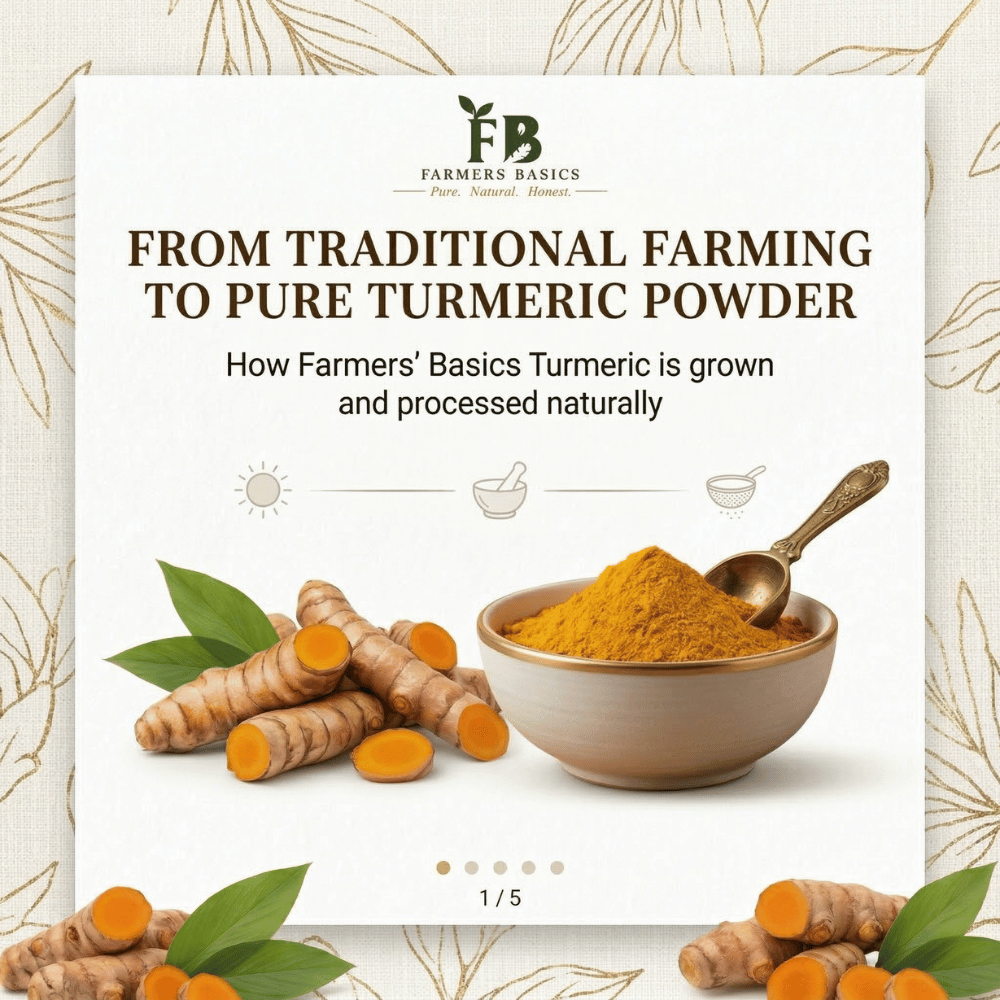
By Farmers Basics March 2026 12 min read Haldi Powder, Organic Turmeric, Traditional Farming, Ayurveda
Pure Organic Turmeric Powder — High Curcumin, Zero Chemicals, Traditional Farming
Farmers Basics Natural Haldi Powder — Sun-Dried · Traditional Seeds · Glass Jar · Chemical-Free
What Makes Our Haldi Different?
Walk into any supermarket in India and you will find dozens of turmeric powder brands — all claiming to be pure, all claiming to be natural. But there is a critical difference between marketing language and the actual farming and processing choices that determine whether the haldi inside the packet is truly good for you.
Farmers Basics haldi is different in five very specific, very deliberate ways — each one rooted in traditional practice and backed by what science now confirms about curcumin preservation and food safety.
1. We Use Traditional Indian Haldi Varieties — Not Hybrid Seeds
Why Traditional Turmeric Varieties Matter
Modern commercial turmeric farming predominantly uses hybrid seeds optimised for high yield — bigger roots, faster growth, more kilos per acre. But hybrid turmeric varieties produce roots with lower curcumin concentration and a blander, less complex aroma than traditional heirloom varieties.
Our farmer partners grow from traditional Indian haldi varieties — specifically heirloom rhizome seeds that have been selected and preserved across generations precisely for their deep golden colour, high natural curcumin content, and distinctive earthy aroma. These are the varieties used in Indian kitchens and Ayurvedic preparations for centuries — not optimised for industrial output, but for genuine nutritional quality.
Traditional varieties like Lakadong turmeric (from Meghalaya) and Alleppey turmeric (from Kerala) are recognised by nutritionists as among the highest curcumin-bearing turmeric types in the world — with curcumin content of 3–5% compared to 1–2% in mass-market hybrid varieties. Our sourcing prioritises these heritage varieties.
2. Natural Farming Practices — Absolutely Zero Chemicals
What Chemical-Free Farming Actually Means on Our Farms
Turmeric is a root crop — it absorbs whatever is in the soil directly into its flesh. This means pesticide residue and chemical fertiliser contamination is particularly serious with turmeric compared to above-ground crops. The root stores whatever the soil contains.
Our farmer partners follow strict natural farming principles:
- No synthetic pesticides or insecticides — pest management uses neem-based preparations, crop rotation, and natural companion planting
- No artificial fertilisers — soil fertility is maintained through vermicompost, farmyard manure, and organic matter
- No chemical ripening agents — roots are harvested at natural maturity, not forced
- No chemical polishing — many commercial turmeric powders are polished with chemicals to enhance colour uniformity; we never do this
We personally verify these practices through farm visits and source documentation before and during each sourcing cycle. This is not a marketing claim — it is a supply chain commitment with real accountability.
3. Traditional Sun-Drying — Preserving Curcumin the Way Nature Intended
Sun-Drying vs Machine-Drying — The Curcumin Difference
After harvesting, fresh turmeric rhizomes need to be dried before grinding. How they are dried is arguably the single most important processing decision — because it directly determines how much of the nutritional value survives.
Industrial machine-drying uses forced hot air at temperatures between 60°C and 90°C to dry turmeric rapidly. This is efficient for production scale — but research consistently shows that high-temperature drying degrades curcumin, destroys volatile oils responsible for aroma, and oxidises the natural pigments that create turmeric’s deep golden colour.
Traditional sun-drying dries the roots slowly over 12–15 days under natural sunlight. The temperature never exceeds 45–50°C at peak sun. This gentle process:
- Preserves natural curcumin content without heat degradation
- Retains the volatile essential oils that give haldi its distinctive, complex earthy aroma
- Maintains the deep, rich golden pigmentation naturally
- Reduces moisture to safe levels without compromising the nutritional profile
The result is a haldi powder that smells unmistakably like fresh turmeric root — not the faint, bland powder that most commercial brands produce after industrial processing.
4. Low-RPM Stone Grinding — No Heat, No Nutrient Loss
Why Grinding Speed Changes Everything
Most people never think about how spice powder is made — but the grinding process is where the final and most critical nutritional loss happens in conventional turmeric production.
High-speed industrial hammer mills and pulverisers operate at thousands of RPM. The friction generated by this speed produces significant heat — sometimes reaching 70–80°C at the grinding surface. This heat is enough to further degrade whatever curcumin and volatile oils survived the drying stage. High-speed grinding also oxidises the fresh-cut powder surface instantly, dulling the colour.
Low-RPM stone grinding — the method we use — processes the dried turmeric roots at slow speeds that generate minimal friction heat. The grinding stone never gets hot enough to damage the curcumin molecules or volatile oils. This is the same principle as traditional stone chakki grinding — the method Indian homes have used for centuries before industrial mills existed.
The practical result you can actually verify yourself:
- Colour: Our haldi is a deep, rich amber-gold — not the pale yellow of high-speed milled commercial turmeric
- Aroma: Open the jar and the earthy, pungent aroma of fresh turmeric is immediately present — a sign of intact volatile oils
- Taste: A slightly warm, distinctly earthy, mildly bitter profile — the full flavour of real turmeric root
5. Glass Jar Packaging — Because Pure Haldi Deserves a Pure Home
Why Glass Beats Plastic for Turmeric Powder
The final decision — packaging — matters more than most consumers realise. Even the purest, best-processed turmeric powder will degrade if stored poorly.
Most commercial turmeric is packed in multi-layer plastic pouches or thin plastic containers. Plastic is permeable — micro-quantities of oxygen and moisture slowly transfer through the walls over time, causing oxidation that degrades curcumin and dulls the colour. Plastic also raises legitimate concerns about chemical leaching into fine powders, particularly in India’s heat.
Farmers Basics packs our haldi in airtight, food-grade glass jars. Glass is completely impermeable — zero oxygen or moisture transfer. It is chemically inert and will never interact with the contents. It maintains the exact same quality on day 365 as on day 1 of opening, provided you use a dry spoon and keep the lid sealed.
The glass jar is also transparent — you can see the deep amber-gold colour of the haldi directly. We consider this transparency both literal and symbolic: we have nothing to hide about what is inside.
Traditional seeds · Natural farming · Sun-dried · Low-RPM ground · Glass jar packed. This is what pure haldi looks like.
Farmers Basics Haldi vs Regular Market Turmeric — Full Comparison
| What We’re Comparing | Farmers Basics Haldi | Typical Market Turmeric |
|---|---|---|
| Seed Variety | ✅ Traditional heirloom varieties (high curcumin) | ❌ High-yield hybrid seeds (lower curcumin) |
| Farming Method | ✅ Chemical-free, natural farming — no pesticides or synthetic fertilisers | ❌ Often uses synthetic pesticides and artificial NPK fertilisers |
| Artificial Colour | ✅ Zero — colour is entirely from natural curcumin | ❌ Many brands add metanil yellow or lead chromate |
| Chemical Polishing | ✅ None — never polished with chemicals | ❌ Common practice to enhance appearance and extend shelf life |
| Drying Method | ✅ Natural sun-drying over 12–15 days | ❌ Industrial hot-air drying at 60–90°C |
| Grinding Method | ✅ Low-RPM stone grinding — minimal heat | ❌ High-speed hammer mills generate heat that degrades curcumin |
| Curcumin Content | ✅ 3–5% natural curcumin (heirloom variety + cold grinding) | ❌ 1–2% in mass-market hybrid varieties after industrial processing |
| Packaging | ✅ Airtight glass jar — zero plastic contact, zero permeability | ❌ Plastic pouches or thin plastic containers |
| FSSAI Certification | ✅ FSSAI certified processing facility | ⚠️ Varies — not all brands display or maintain certification |
| Preservatives | ✅ None — zero additives of any kind | ❌ Some brands use anti-caking agents and moisture absorbers |
Turmeric Health Benefits — What Science Actually Confirms
Turmeric is one of the most studied spices in modern nutritional science — with over 10,000 published peer-reviewed studies examining curcumin and its effects on human health. Here is what is genuinely well-supported by evidence — and what that means for your daily haldi habit.
Anti-Inflammatory Properties — The Science Behind Curcumin
🔬 What Research Shows
Curcumin — the active polyphenol in turmeric — is one of the most comprehensively studied natural anti-inflammatory compounds. It works by inhibiting NF-κB (nuclear factor kappa-light-chain-enhancer of activated B cells) — a protein complex that controls the transcription of inflammatory cytokines. In simpler terms: curcumin blocks the molecular signals that trigger inflammation at the cellular level.
A landmark meta-analysis published in the Journal of Medicinal Food reviewed 8 randomised controlled trials and found curcumin supplementation significantly reduced markers of inflammation including C-reactive protein (CRP) and interleukin-6 (IL-6) — two of the most commonly measured inflammation indicators in clinical medicine.
The key insight for Indian consumers: the curcumin content of your turmeric powder directly determines how much anti-inflammatory benefit you actually get. This is why traditional seed varieties with 3–5% curcumin matter versus hybrid varieties with 1–2%.
Always pair turmeric with black pepper (piperine) — research shows piperine increases curcumin bioavailability by up to 2,000% by inhibiting its rapid metabolism in the liver and intestines.
Immunity and Gut Health — The Two-Way Relationship
Turmeric supports immune health through two distinct mechanisms — and both are relevant to everyday Indian wellness:
Immune Modulation
Curcumin has been shown to enhance the activity of natural killer (NK) cells and T lymphocytes — two key components of the body’s innate immune defence. Regular haldi consumption may support faster immune response to common infections.
Antimicrobial Activity
Turmeric has demonstrated antimicrobial properties against several common bacteria including E. coli and Staphylococcus aureus in laboratory studies. This aligns with its traditional use in Indian cooking as a natural food preservative and digestive protector.
Gut Microbiome Support
Research published in Nutrients journal found curcumin positively influences gut microbiota composition — increasing beneficial bacterial populations while reducing pathogenic ones. A healthy gut microbiome is now recognised as central to overall immune health.
Digestive Anti-Inflammation
Curcumin has shown promising results in studies on inflammatory bowel conditions. Regular small doses of turmeric in cooking may help maintain gut lining integrity and reduce intestinal inflammation over time.
Skin Health from Within
Curcumin’s antioxidant and anti-inflammatory properties work on skin at the cellular level — reducing oxidative damage that causes dullness and uneven tone, and potentially reducing acne-associated inflammation. The inside-out approach to skin health that Indian grandmothers always understood.
Joint and Mobility Support
Several clinical trials have found curcumin supplementation reduced joint pain and stiffness scores in patients with osteoarthritis, with comparable efficacy to some NSAIDs and without their gastrointestinal side effects at standard doses.
Brain and Cognitive Support
Curcumin may increase levels of Brain-Derived Neurotrophic Factor (BDNF) — a growth hormone that supports neuron health and cognitive function. Research also suggests anti-neuroinflammatory properties relevant to long-term brain health.
Cardiovascular Health
Studies show curcumin improves endothelial function — the ability of blood vessel walls to regulate blood flow and pressure. It also supports healthy cholesterol oxidation levels, contributing to overall cardiovascular health maintenance.
Buy Farmers Basics Pure Haldi Powder
Traditional seeds · Chemical-free farming · Natural sun-drying · Low-RPM stone ground · Airtight glass jar · FSSAI certified. Pure haldi — the way it was always meant to be.
How to Use Organic Turmeric Powder Daily — 8 Proven Ways
Haldi is one of the most versatile spices in the Indian kitchen and wellness toolkit. Here are eight practical ways to get the most from your Farmers Basics haldi powder every day.
Haldi Doodh (Golden Milk)
Add ½ tsp haldi to 200ml warm milk with a pinch of black pepper, a teaspoon of honey or jaggery, and a drop of ghee. The classic Indian immunity ritual — backed by science.
Golden Latte
Whisk ½ tsp haldi + pinch of cinnamon + pinch of black pepper into steamed oat or almond milk. Sweeten with honey. The modern version of haldi doodh loved worldwide.
Dal, Sabzi and Curries
Add ¼–½ tsp of haldi to your dal tadka, sabzi, or curry base. Haldi blooms in hot oil — adding at the cooking stage releases its colour, aroma, and anti-inflammatory compounds most effectively.
Morning Turmeric Water
Dissolve ¼ tsp haldi in warm water with lemon juice and a pinch of black pepper. Drink first thing in the morning. A gentle, effective daily anti-inflammatory routine.
Smoothies and Juices
Add ¼–½ tsp haldi to a mango smoothie, banana shake, or green juice. The sweet base completely masks turmeric’s bitterness while delivering full nutritional benefit.
Turmeric Rice
Add ¼ tsp haldi to the water when boiling rice for golden turmeric rice. Delicious, anti-inflammatory, and a beautiful deep gold colour on your plate.
Haldi Face Pack
Mix ¼ tsp haldi with besan (chickpea flour), yoghurt, and a few drops of rose water. Apply to face for 15–20 minutes. The traditional Indian brightening mask — use our pure haldi for consistent, non-staining results.
Turmeric Ginger Tea
Brew fresh ginger tea and add ¼ tsp haldi while it is still hot. Add black pepper and honey. An excellent evening anti-inflammatory wind-down drink, particularly good for joint health and digestion.
Our Farmer Partners and Sourcing Story
Behind every jar of Farmers Basics haldi is a farmer, a field, and a practice that goes back generations. We believe you deserve to know this story.
Direct Partnership with Verified Farmers
We do not source through commodity aggregators or wholesale traders. We work directly with specific, named farm families in turmeric-growing regions of India — primarily in our base region of Haryana and surrounding states. Direct sourcing means traceability, accountability, and the ability to verify what happens at every stage of cultivation.
Preserving Traditional Farming Knowledge
Many of our farmer partners are second and third-generation farmers who have been growing haldi using traditional methods passed down from their parents and grandparents. The traditional seed varieties they maintain, the organic soil management practices they follow, and the sun-drying methods they use are all part of an agricultural tradition that industrial farming is rapidly eroding. We source from these farmers specifically — and pay fair prices that make it economically viable for them to continue traditional practices rather than switching to cheaper, higher-yield chemical farming.
Fair Pricing — Farmers Receive Rightful Value
One of the reasons natural and traditional farming practices disappear in India is purely economic: chemical farming produces more kilos per acre and sells to commodity aggregators at standardised bulk prices. Traditional, chemical-free turmeric gets the same price as chemically grown turmeric in most markets — giving farmers no economic incentive to maintain traditional practices.
Farmers Basics pays premium prices specifically for traditionally grown, chemical-free turmeric. Our direct sourcing removes the aggregator margin and directs that value to the farmer. When pure food is priced fairly, farmers can afford to keep growing it purely.
Transparent Supply Chain — We Know Every Farm
We do not use the word “traceability” as a marketing term. We mean it practically: we know which farmer grew the haldi in each batch, which region it came from, and how it was cultivated. This is possible only because we source directly. We are actively working to make this traceability information available to consumers on our website so you can know your food’s journey.
Support Indian farmers practising traditional, chemical-free cultivation. Every jar you buy keeps a tradition alive.
How to Verify Your Haldi’s Purity at Home — 4 Simple Tests
Turmeric adulteration is rampant in India — a 2022 FSSAI survey found that over 30% of turmeric powder samples tested in India contained adulterants, including metanil yellow dye (a toxic industrial dye), lead chromate, chalk powder, and sawdust. Here is how to check yours.
| Test | What to Do | Pure Haldi Result | Adulterated Haldi Result |
|---|---|---|---|
| Water Test | Dissolve ½ tsp in a glass of cold water. Do not stir — observe for 5 minutes. | Powder settles slowly at the bottom. Water turns slightly yellow but remains mostly clear. | Water turns bright, intense yellow immediately. Powder dissolves fully (starch or chalk added). |
| Colour Test | Observe the powder colour in natural daylight. | Deep amber-gold with slight brownish tones — natural curcumin colour. | Unnaturally bright yellow or vivid orange — artificial dye added to mask poor quality. |
| Aroma Test | Place a pinch on your palm and bring close to your nose. | Strong, earthy, distinctly pungent aroma — like fresh turmeric root. | Weak, bland, or faintly chemical smell — diluted or artificially enhanced. |
| HCl Test (for lead chromate) | Add a few drops of hydrochloric acid (HCl) to a small amount of turmeric. | No visible reaction or colour change. | Solution turns purple — indicates lead chromate adulteration. |
Haldi for Every Purpose — Cooking, Wellness, Skin and More
Whether you are searching for turmeric for immunity, the perfect haldi doodh recipe, a golden latte for your morning routine, or organic haldi for skin — Farmers Basics haldi works beautifully for every purpose because its natural curcumin content is genuinely high and its aroma and colour are fully preserved.
Turmeric for Immunity — The Daily Ritual
The traditional Indian haldi doodh is not superstition — it is evidence-based nutrition that Indian families understood intuitively long before modern immunology existed. Curcumin’s ability to modulate both innate and adaptive immune responses means daily haldi milk genuinely supports your immune system’s baseline function. The key is consistency — daily use of half a teaspoon with black pepper and warm milk, over 4–6 weeks minimum.
Golden Latte — The Modern Haldi Ritual
The global wellness trend of golden lattes is simply haldi doodh repackaged for modern café culture. Use ½ tsp Farmers Basics haldi + pinch of ground black pepper + pinch of cinnamon + your preferred milk. Sweeten with honey. Our high-curcumin, strong-aroma haldi makes a noticeably superior golden latte compared to pale, weak commercial turmeric powders — the deep colour, the distinct flavour, and the genuine warmth on the palate are immediately apparent.
Turmeric for Skin — Inside and Outside
For internal skin health: daily haldi milk or turmeric water delivers curcumin’s antioxidant protection to skin cells from within. The reduction in systemic inflammation that curcumin supports also directly affects skin clarity and tone over time.
For external use: our pure haldi (with zero artificial colour or chemicals) is ideal for traditional haldi face packs. Commercial turmeric with artificial yellow dye will stain skin unnaturally — our haldi gives the traditional gentle, natural golden result. Mix with besan and fresh yoghurt for a weekly brightening mask.
Anti-Inflammatory Spice — For Joint and Muscle Health
Whether you are dealing with post-exercise muscle soreness, general stiffness, or age-related joint discomfort, regular daily turmeric consumption can be a meaningful dietary support — particularly when using genuine high-curcumin varieties. Combine with black pepper, consume with fatty food or warm milk for maximum absorption, and be consistent for at least 6–8 weeks before evaluating results.
Organic Haldi for Cooking — Flavour That Makes a Difference
Beyond wellness, traditional haldi simply makes food taste better. The deep, complex, slightly earthy bitterness of high-quality turmeric adds a genuine flavour dimension to dal, sabzi, rice, and curries that pale industrial turmeric cannot replicate. Our farmer partners’ haldi is grown for flavour as much as nutrition — the traditional varieties have a complexity and warmth that hybrid varieties bred purely for yield simply do not have.
Customer Questions Answered
Experience the Difference of Truly Pure Haldi
Traditional seeds. Natural farming. Sun-dried. Low-RPM stone ground. Airtight glass jar. FSSAI certified. This is not just turmeric powder — it is India’s haldi tradition preserved in a jar.
People also search for
Found this helpful? Share with someone who cares about pure food.